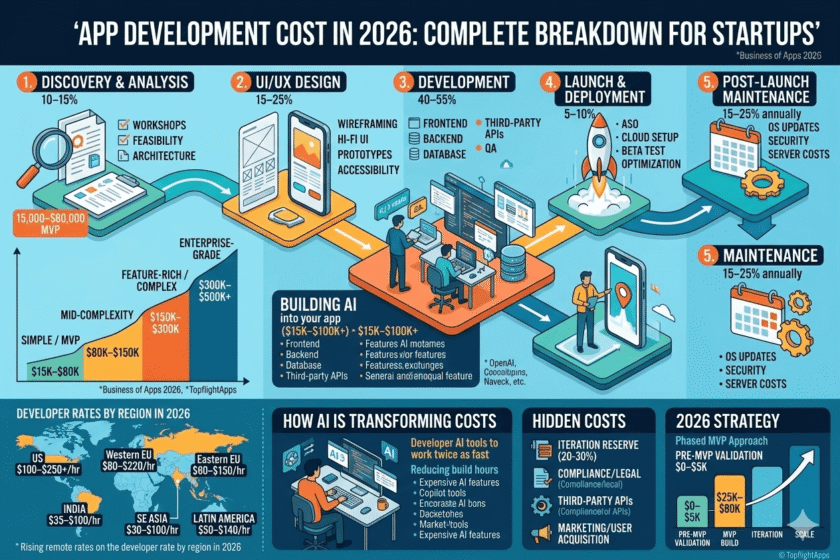
App Development Cost in 2026: Complete Breakdown for Startups
If you’re looking for app development costs in 2026, you’re asking the right question at the right time. The app market is expected to grow to over $626 billion by 2030. And the stakes for app users – along with app prices – have never been higher. But the flip side is: AI-powered app development tools haven’t only increased the prices; they’ve also accelerated the app creation process.
This guide goes beyond generic price ranges. We break down every cost factor phase by phase, compare 2025 vs. 2026 pricing shifts, show you how AI is reshaping budgets, and expose the gaps that most competitor articles fail to cover.
| 💡 | App development costs vary from $15,000 for a simple MVP to $500,000+ for enterprise apps in 2026. On average, funded startups spend $80,000 to $250,000 (Business of Apps, 2026). Development time is cut in half by AI tools, 30-50%, but user expectations have also increased accordingly. |
1. Why 2026 Is a Different Ballgame from 2025
Most cost guides recycle old numbers. Here’s what actually changed between 2025 and 2026 — and why it matters for your budget.
| Factor | 2025 Reality | 2026 Verified Data |
| AI Coding Tools | Emerging, experimental | Standard — saves 30–50% dev time (iCoderz, 2026) |
| Cross-Platform Frameworks | Good but gap vs. native | Flutter/React Native: 90–95% native parity at 60–70% cost (nadcab, 2026) |
| User Expectations | Fast, clean UI | Personalization, AI features, 5G performance as baseline |
| Security Requirements | Optional for small apps | Baseline requirement — adds $5K–$30K to budgets |
| Generative AI Integration | Premium feature | AI adds 20–50% to baseline dev cost (logic-square, 2026) |
| Average MVP Cost | $20,000–$40,000 | $15,000–$80,000 depending on complexity (multiple sources, 2026) |
| Developer Hourly Rate (US) | $100–$150/hr | $75–$250+/hr; avg. mid-level $120–$150/hr (Naveck, 2026) |
| Offshore Rate (India/SE Asia) | $25–$45/hr | $20–$60/hr; rates rising due to global demand (innov8world, 2026) |
The key insight: AI made developers faster. But the complexity of what users expect has risen proportionally. So you get more apps for your money. But a ‘good enough’ app in 2025 is ‘below average’ in 2026.
Note: Looking for mobile-app-development-services that deliver real results? Trusted by growing brands. Limited slots available—get started today.
2. App Development Cost by Complexity (2026 Ranges)
The single biggest cost driver is complexity. Here’s an honest assessment of what costs look like in the real world:
| App Type | Example | Timeline | 2026 Verified Cost Range |
| Simple / MVP | To-do app, loyalty card, basic utility | 1–3 months | $15,000 – $80,000 |
| Mid-Complexity | Fitness tracker, e-commerce, SaaS tool | 2–5 months | $80,000 – $150,000 |
| Feature-Rich / Complex | On-demand marketplace, fintech, social app | 6–12 months | $150,000 – $300,000 |
| Enterprise-Grade | Telehealth, banking, multi-region platform | 12–18+ months | $300,000 – $500,000+ |
| AI-First App | LLM chatbot, recommendation engine, vision AI | 4–10 months | $60,000 – $300,000 |
Source: Verified across multiple 2026 market reports including topflightapps.com, dbbsoftware.com, naveck.com, and nadcab.com (all February 2026).
3. Phase-by-Phase Cost Breakdown
Your competitors will usually show you a single number. Smart founders want to know where every dollar goes. Here’s the honest assessment of what your app development costs look like:
Phase 1: Discovery & Business Analysis (10–15% of budget)
What’s Included in Discovery
This is the most underfunded phase – and the most impactful. Teams that dedicate at least 20% of their total budget to pre-development (Discovery + Design) are 3x more likely to build a successful product.
Typical Discovery Deliverables & Costs
- Stakeholder interviews and requirement workshops: $2,000–$8,000
- Technical feasibility study and architecture planning: $3,000–$10,000
- Competitive analysis and market positioning: $1,000–$5,000
- Full technical specification document: $3,000–$8,000
Phase 2: UI/UX Design (15–25% of budget)
Why Design Is a Retention Tool, Not a Luxury
Design is not a luxury – it’s a retention strategy. Bad UX can kill your app quietly through attrition, not crashes.
UI/UX Cost Breakdown
- User research and persona development: $3,000–$7,000
- Wireframing (low fidelity): $2,000–$5,000
- High-fidelity UI design and brand system: $5,000–$20,000
- Interactive prototypes: $3,000–$8,000
Accessibility Note
- Accessibility design (WCAG compliance): $2,000–$6,000
Phase 3: Development (40–55% of budget)
Frontend, Backend & QA Costs
The single biggest cost center is divided between frontend, backend, and quality assurance.
| Development Component | Simple App | Mid-Complexity | Complex App |
| Frontend (iOS/Android/Web) | $10,000–$20,000 | $25,000–$60,000 | $60,000–$150,000 |
| Backend & API Development | $5,000–$15,000 | $20,000–$50,000 | $50,000–$120,000 |
| Database Architecture | $2,000–$8,000 | $8,000–$20,000 | $20,000–$50,000 |
| Third-Party Integrations | $3,000–$10,000 | $10,000–$25,000 | $25,000–$60,000 |
| QA & Testing | $5,000–$12,000 | $12,000–$30,000 | $30,000–$80,000 |
Phase 4: Launch & Deployment (5–10% of budget)
Go-Live Cost Checklist
- App Store submission & optimization (ASO): $2,000–$6,000
- Cloud infrastructure setup (AWS/GCP/Azure): $3,000–$12,000
- Beta testing and soft launch: $2,000–$8,000
- Performance optimization: $3,000–$10,000
Phase 5: Post-Launch Maintenance (15–25% of initial cost, annually)
The Ongoing Cost Most Founders Forget
This is the biggest blind spot for most articles about cost. Your app doesn’t stop costing money when you launch. It’s an ongoing investment.
Annual Maintenance Cost Breakdown
- Year 1 maintenance: 15–50% of initial build cost (higher due to user feedback implementation)
- OS compatibility updates (iOS/Android release cycles): $3,000–$15,000/year
- Security patches: $2,000–$10,000/year
- Server & infrastructure: $200–$5,000+/month depending on user scale
App Store Fees
- App Store fees: $99/year (Apple) + $25 one-time (Google)
4. Platform Choice: iOS vs. Android vs. Cross-platform
In 2026, this choice will be more about strategy and budget than performance.
| Platform | Typical Cost | Best For | Key Tradeoff |
| iOS Only (Native Swift) | $40,000–$150,000 | Monetization-first, premium users | Misses 72% of global market |
| Android Only (Native Kotlin) | $35,000–$140,000 | Global reach, emerging markets | Lower avg. revenue per user |
| Cross-Platform (Flutter/React Native) | $50,000–$150,000 | Most startups — best ROI | 30–40% cost saving, 95% native parity |
| Both Native (iOS + Android) | $100,000–$300,000 | High-performance, enterprise | 2x development cost |
| Progressive Web App (PWA) | $15,000–$60,000 | Content apps, low-budget MVPs | No App Store distribution |
| 🏆 2026 RECOMMENDATION | For most startups: Cross-platform development using Flutter or React Native. You’ll get iOS and Android from a single codebase, saving 30-40% on development costs, and native performance for 95% of use cases. Native development only if you have a use case that requires direct hardware access (AR/VR, sensors, gaming, etc.). |
5. Developer Hourly Rates by Region (2026)
Where you hire is as important as who you hire. Note that all rates mentioned hereafter come directly from real-time sources in 2026, including ZipRecruiter, Adalo, innov8world, index.dev, and Naveck (February 2026).
| Region | Junior Dev | Mid-Level Dev | Senior Dev | Verified Source |
| USA (National Average) | $60–$75/hr | $100–$150/hr | $150–$250+/hr | ZipRecruiter Feb 2026: avg. $52.64/hr (in-house); agencies $100–$200/hr |
| USA (San Francisco / NYC) | $80–$120/hr | $150–$200/hr | $200–$300+/hr | Naveck 2026: senior engineers $250+/hr |
| Western Europe (UK, Germany) | $64–$80/hr | $80–$108/hr | $108–$220/hr | index.dev 2026: contractors $64–$108/hr |
| Central & Eastern Europe (Poland, Romania) | $45–$60/hr | $60–$90/hr | $90–$150/hr | index.dev 2026: CEE $45–$70/hr contractors |
| India | $20–$35/hr | $35–$60/hr | $60–$100/hr | innov8world Dec 2025: $20–$40/hr senior range |
| Southeast Asia (Philippines, Vietnam) | $15–$30/hr | $30–$55/hr | $55–$100/hr | Adalo 2026: Asian developers $15–$30/hr |
| Latin America (Colombia, Argentina) | $30–$50/hr | $50–$90/hr | $90–$140/hr | Arc.dev 2026: nearshore US timezone advantage |
5. Developer Hourly Rates by Region (2026)
Where you hire is as important as who you hire. Note that all rates mentioned hereafter come directly from real-time sources in 2026, including ZipRecruiter, Adalo, innov8world, index.dev, and Naveck (February 2026).
| Region | Junior Dev | Mid-Level Dev | Senior Dev | Verified Source |
| USA (National Average) | $60–$75/hr | $100–$150/hr | $150–$250+/hr | ZipRecruiter Feb 2026: avg. $52.64/hr (in-house); agencies $100–$200/hr |
| USA (San Francisco / NYC) | $80–$120/hr | $150–$200/hr | $200–$300+/hr | Naveck 2026: senior engineers $250+/hr |
| Western Europe (UK, Germany) | $64–$80/hr | $80–$108/hr | $108–$220/hr | index.dev 2026: contractors $64–$108/hr |
| Central & Eastern Europe (Poland, Romania) | $45–$60/hr | $60–$90/hr | $90–$150/hr | index.dev 2026: CEE $45–$70/hr contractors |
| India | $20–$35/hr | $35–$60/hr | $60–$100/hr | innov8world Dec 2025: $20–$40/hr senior range |
| Southeast Asia (Philippines, Vietnam) | $15–$30/hr | $30–$55/hr | $55–$100/hr | Adalo 2026: Asian developers $15–$30/hr |
| Latin America (Colombia, Argentina) | $30–$50/hr | $50–$90/hr | $90–$140/hr | Arc.dev 2026: nearshore US timezone advantage |
Important 2026 Finding: Remote rates in India and SE Asia are increasing due to global competition in remote teams. The cost difference to Western markets is closing. The best cost model continues to be a hybrid team of a US/EU product lead and offshore engineers, saving 35-42% over fully onshore teams (index.dev, 2026).
6. How AI Is Transforming App Development Costs in 2026
This is the section that all other competing articles either skip or gloss over as an afterthought. AI is not just a feature you add; it’s fundamentally changing the way you build applications and the cost of doing so.
6a. AI as a Development Tool (Reducing Your Costs)
How AI Coding Tools Cut Development Hours
The reality is that AI coding assistants, GitHub Copilot, Cursor, Anthropic Claude, and so forth, are now ubiquitous in every professional developer’s toolkit. The reality is that.
| AI Tool Category | What It Does | Cost Savings Impact |
| AI Code Generation (Copilot, Cursor) | Autocompletes code, generates boilerplate, suggests fixes | 20–40% reduction in coding hours |
| AI Testing Automation | Auto-generates test cases, finds edge cases | 15–30% reduction in QA cost |
| AI Design Tools (Figma AI, Uizard) | Generates UI mockups from prompts or sketches | 10–25% reduction in design hours |
| AI Documentation | Auto-writes API docs, code comments | 5–10% reduction in total project time |
| AI Project Management (linear.app AI) | Auto-prioritizes backlogs, predicts delays | Reduces costly mid-project pivots |
Net Impact on Your Budget
Bottom line: The skilled developer using AI tools today could potentially produce 1.5x to 2x the output that a developer without AI tools could produce. That means that your $100,000 app could have cost $140,000 to $180,000 just two years ago!.
6b. Building AI Into Your App (Adding Costs, Adding Value)
AI Feature Cost Breakdown by Type
The other side of the equation: Adding AI features to your app is expensive, but could give you huge competitive advantages.
| AI Feature | Typical 2026 Cost to Build | Use Case Examples |
| LLM Chatbot / AI Assistant | $15,000–$60,000 | Customer support, onboarding, in-app Q&A |
| Personalization Engine | $20,000–$80,000 | Product recommendations, content feeds |
| Computer Vision / Image Recognition | $25,000–$100,000 | Medical imaging, retail try-on, safety checks |
| Voice AI / NLP | $20,000–$75,000 | Voice commands, transcription, sentiment analysis |
| Predictive Analytics Dashboard | $15,000–$50,000 | SaaS admin panels, business intelligence |
| Custom ML Model (from scratch) | $50,000–$300,000+ | Specialized use cases requiring proprietary data |
| Pre-trained API Integration (OpenAI, Gemini) | $5,000–$20,000 setup + ongoing API costs | Fastest path to AI features |
| 💡 AI COST HACK | Most startups should not train their own models. Instead, use pre-trained APIs like OpenAI, Google Gemini, Anthropic Claude API, and build thin integration layers on top of them. This reduces the cost of building AI features by 60-80% compared to building custom models from scratch. Reconsider building custom models when you have enough proprietary data and product-market fit. |
6c. Ongoing AI Infrastructure Costs
Monthly Operational Costs Nobody Budgets For
Not only do AI features have development costs, but they also have operational costs, which are often overlooked in most financial planning guides. The table below reflects the current cost, based on verified pricing data from OpenAI’s API, last updated in February 2026:
| AI Model / Service | Input Cost | Output Cost | Monthly Est. (medium app) |
| GPT-4o (OpenAI) | $2.50 / 1M tokens | $10.00 / 1M tokens | $150–$2,000+/mo |
| GPT-4o Mini (OpenAI) | $0.15 / 1M tokens | $0.60 / 1M tokens | $20–$300/mo |
| GPT-5 (OpenAI) | $1.25 / 1M tokens | $10.00 / 1M tokens | $100–$1,500+/mo |
| GPT-5 Nano (OpenAI) | $0.05 / 1M tokens | $0.40 / 1M tokens | $5–$100/mo |
| Batch API (50% off) | Half standard rate | Half standard rate | Best for non-realtime tasks |
Source: OpenAI official API pricing page, February 2026. The cost of using AI features directly depends on the number of users. An application used by 10,000 users daily can cost $500–$5,000 per month in token charges alone.
Other Monthly AI Infrastructure Line Items
- Vector database hosting for RAG apps (Pinecone, Weaviate): $70–$2,000+/month
- GPU compute for custom model inference (AWS/GCP): $500–$10,000+/month
- Cloud hosting for mid-sized app (10K DAU): $500–$2,000/month (nadcab, 2026)
Quarterly Costs
- AI model monitoring and retraining: $1,000–$5,000/quarter
7. App Development Cost by Industry & Category (2026)
The kind of app you are developing can significantly affect costs. Regulated industries and data requirements can greatly increase costs.
| App Category | 2026 Cost Range | Key Cost Drivers |
| E-commerce / Marketplace | $80,000–$300,000 | Payment gateway, inventory, seller dashboards, logistics APIs |
| Healthcare / Telemedicine | $150,000–$500,000+ | HIPAA compliance, EHR integration, video calls, security audits |
| Fintech / Banking | $200,000–$800,000+ | PCI-DSS compliance, fraud detection, real-time transactions, KYC/AML |
| EdTech / E-learning | $60,000–$200,000 | Video streaming, progress tracking, quiz engines, LMS integration |
| SaaS / B2B Tools | $80,000–$250,000 | Multi-tenant architecture, subscription billing, admin dashboards |
| Social Networking | $150,000–$500,000 | Real-time messaging, media uploads, content moderation, feeds |
| On-demand Services (Uber model) | $200,000–$600,000 | Dual-sided marketplace, real-time matching, geolocation, payments |
| Gaming | $50,000–$500,000+ | Game engine, multiplayer backend, in-app purchases, analytics |
| IoT / Wearables | $80,000–$250,000 | BLE integration (~$9K per device), real-time data sync, dashboards |
| AR / VR Applications | $100,000–$400,000+ | ARKit/ARCore, 3D assets, performance optimization |
8. Hidden Costs Competitors Don’t Tell You About
This is the part of the chapter where real cost planning begins, rather than wishful thinking. These are the cost items that frequently blindside first-time app founders.
8a. The Iterative Refinement Tax
After the launch, users will tell you everything you got wrong. A common mistake is to budget solely for the ‘launch version,’ without considering the budget for iteration. Data from real-world apps shows that successful apps can expect 2-4 major iterations in their first year. Budget 20-30% of your build cost as an iteration reserve.
8b. App Store Review & Compliance
- Apple App Store review: 1–3 day wait, potential rejection requiring rework ($2,000–$10,000 if significant)
- Google Play review: 3–7 day wait, policy compliance audits
- App Store Optimization (ASO) ongoing: $500–$3,000/month
- Privacy policy and terms of service (legal review): $1,500–$5,000
8c. Third-Party API & Service Costs
Most apps rely on external services that add monthly costs after launch:
- Payment processing (Stripe): 2.9% + $0.30 per transaction
- Push notifications (Firebase): Free up to 10M/day, then $0.01/1K
- Maps & Geolocation (Google Maps): $7/1,000 dynamic map loads
- SMS verification (Twilio): $0.0079/SMS
- Analytics (Mixpanel, Amplitude): $0–$2,000+/month
- Cloud storage (AWS S3): $0.023/GB/month
8d. Accessibility & Compliance (The Overlooked 10%)
In 2026, accessibility is not a nice-to-have for serious applications. WCAG 2.1 compliance, screen reader support, and color contrast requirements require additional development time. Plan on spending $5,000 to $20,000 on accessibility work, depending on the complexity of your app. Don’t bother with accessibility, and you can lose up to 15% of potential customers and face legal risks.
8e. Security Audits
Post-launch security audits (penetration testing) are vital for apps that handle user data or process transactions. Cost: $5,000 to $30,000 per audit, to be performed annually or before major releases.
8f. Marketing & User Acquisition
Building it does not mean they will come. The cost of acquiring users for the first year can be the same as or even higher than the cost of building the app for consumer-facing apps:
- App Store paid acquisition: $1–$5 per install for most categories
- Social media advertising: $2,000–$20,000/month for meaningful traction
- Content/SEO: $2,000–$8,000/month
- Influencer partnerships: $500–$50,000+ per campaign
9. Build vs. Buy vs. Low-Code: The 2026 Decision Framework
Not all startups need a fully custom-built app from scratch. Understanding your options can save you a significant amount of budget.
| Approach | Cost Range | Best For | Key Limitation |
| Custom Development | $40K–$500K+ | Unique product vision, competitive moat | Highest cost and time to market |
| Low-Code (Bubble, FlutterFlow) | $5,000–$50,000 | MVPs, non-technical founders, internal tools | Scalability limits, vendor lock-in |
| No-Code (Webflow, Glide) | $0–$10,000 | Landing pages, simple apps, proof of concept | Very limited custom logic |
| White-Label Solutions | $10,000–$80,000 | Common models (e-commerce, booking, delivery) | Limited differentiation |
| SaaS Platform Extension | $5,000–$30,000 | Adding to existing ecosystems (Shopify, Salesforce) | Dependent on platform ecosystem |
| 💡 PRO TIP | A smart hybrid model in 2026 for startups will be to use a low-code platform (Bubble, FlutterFlow) to quickly validate your idea for $5K-$15K, then invest in custom development once you have product-market fit. This can save you $50K to $150K in unnecessary engineering costs. |
10. Outsourcing vs. In-House vs. Freelance: Real Cost Comparison
| Model | Average Monthly Cost | Best For | Key Risk |
| In-House Team (US) | $50,000–$120,000/mo (3 devs) | Long-term products, IP-sensitive work | Highest burn, slow to hire |
| Agency (US/EU) | $20,000–$80,000/mo | Full-service, turnkey development | Higher rates, may juggle multiple clients |
| Agency (Offshore) | $8,000–$30,000/mo | Budget-conscious startups | Communication overhead, quality variance |
| Freelancers (Platform) | $3,000–$20,000/mo | Specific skills, supplemental work | No accountability, coordination burden |
| Hybrid (PM in-house + offshore devs) | $15,000–$40,000/mo | Best value for funded startups | Requires strong in-house leadership |
11. The 2026 MVP Strategy: Spend Less, Validate Faster
The smartest founders in 2026 are not developing full apps on day one. Instead, they are using a phased approach, which dramatically reduces financial risks.
Phase 0: Pre-MVP Validation ($0–$5,000)
- Build a clickable prototype in Figma or Marvel
- Run 20–30 user interviews to validate the core problem
- Test willingness to pay with a landing page and waitlist
- Use AI tools to simulate AI features before building them
Phase 1: MVP Build ($25,000–$80,000)
- Build only the one core feature that solves the validated problem
- Use cross-platform frameworks to cover iOS + Android from one codebase
- Integrate pre-built APIs rather than custom solutions
- Skip admin panels, analytics dashboards, and secondary features
Phase 2: Iteration ($20,000–$60,000 per cycle)
- Implement features based on real user behavior data, not assumptions
- Use analytics (Mixpanel, Amplitude) to guide every decision
- Optimize conversion funnels before adding new features
Phase 3: Scale ($100,000+)
- Performance optimization for 10x, 100x user growth
- Advanced AI features, enterprise integrations, compliance certifications
- Expand platform coverage (web app, wearables, tablets)
12. Startup Budget Decision Guide: Where Should You Spend?
If you have a fixed budget, here is a framework on how to spend it wisely:
| Your Budget | Recommended Approach | What You Can Realistically Build |
| Under $15,000 | No-code / low-code MVP only | Proof of concept, landing page + waitlist, Glide/Bubble app |
| $15,000–$40,000 | Low-code MVP or very simple custom app | Single-feature MVP, one platform, basic backend |
| $40,000–$80,000 | Solid cross-platform MVP | Core feature set, 2 platforms via Flutter, basic analytics |
| $80,000–$150,000 | Competitive mid-market app | Custom UI, payment integration, user accounts, basic AI feature |
| $150,000–$300,000 | Full-featured startup product | Multiple integrations, AI features, admin dashboard, both platforms native |
| $300,000+ | Enterprise-ready platform | Compliance, scalability, advanced AI, multi-region infrastructure |
13. Questions to Ask Any App Development Agency Before Signing
Most founders sign these contracts without asking the right questions. These are the ones that will save you from costly surprises:
- Do you charge for the discovery phase separately? (If not, their estimate is guesswork.)
- What’s your change order policy when scope evolves?
- Who specifically will be working on my project — senior or junior developers?
- How do you handle post-launch bugs — is there a warranty period?
- Can I see examples of apps you’ve built at a similar complexity level?
- What’s your process for knowledge transfer if we decide to bring development in-house?
- Do your estimates include QA, deployment, and App Store submission?
- How do you handle third-party API costs — are they in the estimate or extra?
- What project management methodology do you use, and how will I stay updated?
- Have you built AI-integrated apps before, and can you walk me through the architecture?
14. Final Takeaway: Building Smart in 2026
App development in 2026 is not just about finding the lowest bid, but also about making decisions that compound over time. The startups that win are those that validate before they build, strategically choose their technology stack, leverage AI tools to extend their runway, and treat their app as a living product rather than a one-time expense.
Regardless of whether you have $30,000 or $300,000 to invest, the principles will be the same: start lean, learn fast, and iterate with data. The best app development companies are not simply order-takers; they’re strategic partners that will help you optimize your investment and get the most out of your budget.